
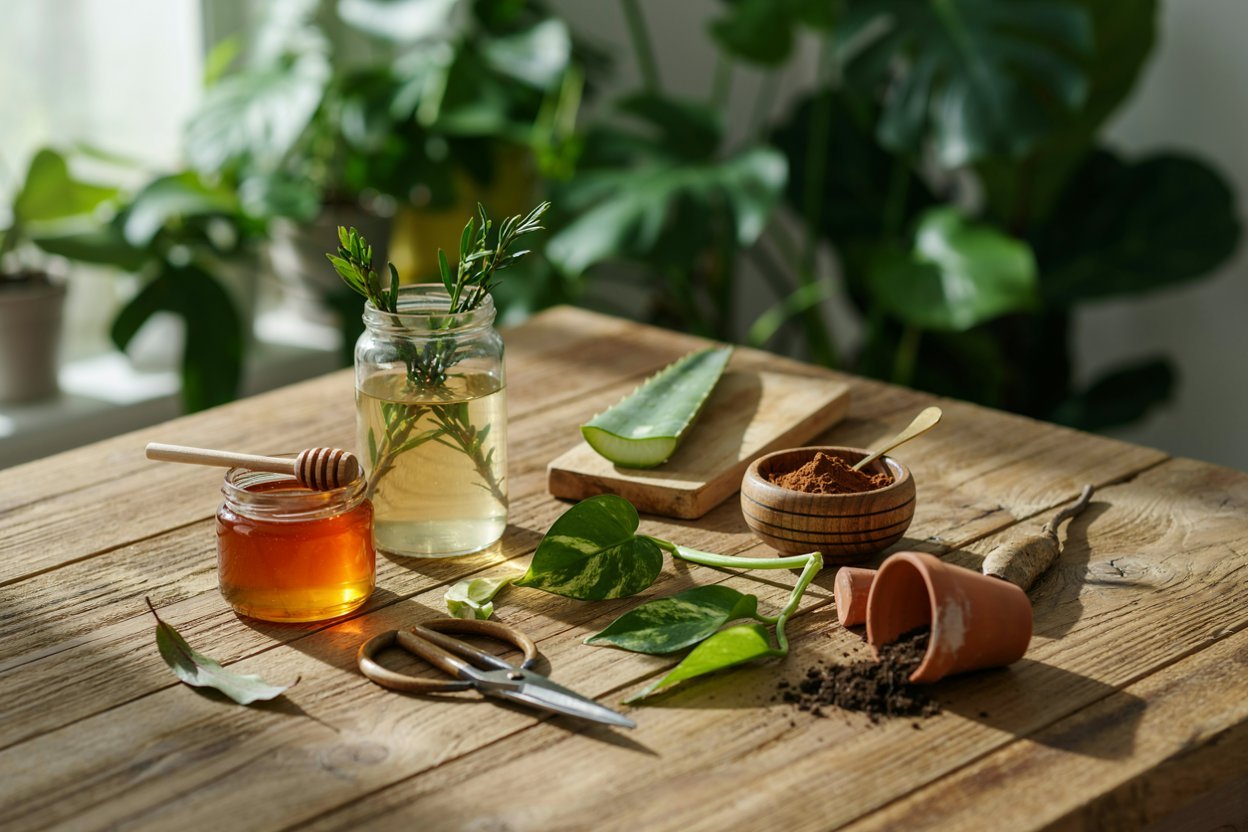

Propagating plants from cuttings has always felt a little magical to me. I still love the moment when I gently pull a cutting from its propagation medium and discover tiny white roots growing underneath. It means a simple piece of a plant has successfully started a brand-new life.
Of course, not every cutting roots easily. Some plants seem ready to grow roots almost overnight, while others need much more encouragement. That is where an organic rooting hormone—or more accurately, a natural rooting aid—can be helpful.
If you prefer a more natural approach to gardening, you may have heard about using ingredients such as willow water, aloe vera, honey, or cinnamon when propagating plants. However, it is important to understand that not all popular DIY recipes actually contain rooting hormones. Some ingredients mainly help protect the cutting from fungal problems or rot, while others may support the rooting environment.
In this guide, I am sharing a practical and honest way to make and use a natural rooting aid at home. I will also explain which ingredients are genuinely useful, the tools you need, how to prepare your cuttings, and the mistakes that can stop a cutting from rooting.
Important note: Willow water is generally considered the strongest natural option because willow contains naturally occurring compounds associated with rooting and plant wound responses. Honey and cinnamon are better viewed as protective helpers rather than true replacements for commercial rooting hormones.
What Is Organic Rooting Hormone?
A rooting hormone is a substance used to encourage the development of roots on plant cuttings.
Commercial rooting products usually contain concentrated plant-growth substances called auxins, which help stimulate root development. Natural or homemade alternatives are usually much gentler and less concentrated.
That means an organic DIY rooting mixture should not be expected to perform exactly like a professionally formulated commercial rooting powder or gel, especially with difficult woody plants.
However, natural rooting aids can still be useful because they may:
- Help support healthy propagation conditions
- Reduce the risk of rot on vulnerable cuttings
- Help protect freshly cut plant tissue
- Encourage successful propagation of easy-to-root plants
- Provide a natural alternative for gardeners who enjoy DIY methods
The biggest secret to successful propagation is something I always like to remind gardeners of: rooting hormone alone cannot rescue a poorly prepared cutting.
Healthy plant material, clean tools, proper moisture, warmth, and suitable light are just as important.
The Best Natural Ingredient for Homemade Rooting Hormone: Willow
If you want to make a natural rooting solution that comes closest to a genuine homemade rooting hormone, willow water is the best place to start.
Willow has a long history of being used in plant propagation. Willow tissues contain naturally occurring compounds associated with plant growth and wound responses, including substances discussed in relation to auxin activity.
This is why willow water is often considered more useful as a rooting aid than many popular kitchen ingredients.
For my preferred homemade recipe, I like to think of the ingredients this way:
- Willow water = the main natural rooting base
- Aloe vera = a gentle supportive coating
- Honey = optional protective ingredient
- Cinnamon = optional antifungal support for soil propagation
You do not need to combine every ingredient into one heavy mixture. In fact, keeping the recipe simple is often better.
Ingredients Needed for Organic Rooting Hormone
Main Ingredients
1. Fresh Willow Twigs
Fresh young willow twigs are the most important ingredient for making willow water.
Look for:
- Young, flexible twigs
- Fresh green growth
- Healthy branches
- Clean plant material without obvious disease
Young willow growth is generally preferred over old, dry, woody branches.
How Much You Need
A good starting amount is:
- A handful of fresh young willow twigs
- Enough clean water to cover the chopped willow
The exact amount does not need to be perfect. Homemade willow water is not a precisely standardized product, so think of this as a practical gardener’s recipe rather than an exact laboratory formula.
2. Clean Water
Use clean water to prepare the willow solution.
You can use:
- Filtered water
- Clean tap water
- Distilled water
If your tap water is heavily treated or has an unusually strong chlorine smell, filtered water may be a better choice for delicate propagation.
Optional Supporting Ingredients
3. Fresh Aloe Vera Gel
Aloe vera is a popular natural ingredient for plant propagation.
It is often used because it can provide moisture and has properties that may help support a healthier environment around the freshly cut stem. However, aloe should not be treated as a direct substitute for a concentrated auxin-based rooting hormone.
You can use:
- Fresh gel from an aloe vera leaf, or
- Plain, simple aloe gel without unnecessary additives
For the best results, I prefer fresh aloe from the plant when it is available.
4. Raw Honey
Honey is another popular ingredient in DIY propagation recipes.
Honey does not provide the same kind of concentrated rooting stimulation as a commercial auxin product. Instead, its main potential benefit is helping protect the freshly cut area.
Use:
- A small amount of plain raw honey
You only need enough to lightly coat the end of the cutting.
5. Ground Cinnamon
Cinnamon is widely promoted as a homemade rooting hormone, but I think it is important to be honest here: cinnamon is not a true rooting hormone.
Its most useful role in propagation is as a supportive antifungal ingredient. It may help reduce fungal problems around vulnerable cuttings, especially when rooting in a moist medium.
Use:
- A small amount of plain ground cinnamon
A light dusting is enough.
Tools You Will Need
Before making your organic rooting solution, gather everything you need.
Essential Tools
1. Clean Pruning Shears or Garden Scissors
Use sharp, clean shears to:
- Collect willow twigs
- Take plant cuttings
- Trim stems
A clean cut is very important because damaged or crushed stems are more likely to struggle.
2. Sharp Knife
A clean knife can help you:
- Chop willow twigs
- Make precise cuts
- Trim thick plant stems
Always keep gardening tools clean before using them on cuttings.
3. Cutting Board
Use a cutting board or another clean surface when chopping your willow.
This keeps your work area organized and prevents the willow from becoming contaminated with garden debris.
4. Glass Jar or Bowl
You will need a clean container for soaking the willow.
A glass jar, bowl, or large measuring container works well.
5. Measuring Cup or Jug
This helps you add and manage your water.
Exact measurements are less important than keeping your mixture reasonably consistent from one batch to another.
6. Fine Strainer
A strainer is useful for removing pieces of willow after the liquid has steeped.
You can also use clean cheesecloth if necessary.
7. Small Bowl
Keep a small bowl nearby if you are using:
- Aloe vera gel
- Honey
- Cinnamon
This makes it easier to apply small amounts to the cuttings.
8. Clean Propagation Pots or Containers
Prepare your containers before taking your cuttings.
You can root plants in:
- Small nursery pots
- Propagation trays
- Clean containers
- Suitable jars for water propagation
Clean containers are important because old soil and dirty pots can introduce problems to fresh cuttings.
9. Labels
This might sound like a tiny detail, but labels can save you a lot of confusion.
Write down:
- The plant name
- The date
- The propagation method
When you propagate several plants at once, everything can start looking surprisingly similar!
How to Make Willow Water for Plant Cuttings
Now let us get to the most important part: making the natural rooting solution.
Step 1: Collect Fresh Willow Growth
Collect healthy young willow twigs.
Choose fresh, flexible growth rather than old, dry branches.
Avoid using plant material that appears:
- Diseased
- Heavily damaged
- Covered with obvious pests
The cleaner and healthier your starting material is, the better.
Step 2: Wash the Willow Twigs
Rinse the twigs gently with clean water to remove:
- Soil
- Dust
- Small insects
- Surface debris
You do not want garden dirt sitting in your rooting solution.
Step 3: Chop the Willow into Small Pieces
Use clean pruning shears or a knife to chop the willow twigs into smaller sections.
Smaller pieces expose more of the plant material to the water.
Place the chopped willow into your clean jar or bowl.
Step 4: Add Water
Pour clean water over the chopped willow until the plant material is fully covered.
You can prepare willow water using a soaking method and allow the willow to steep for a period of time. Homemade methods vary, but steeping fresh chopped willow for roughly 24 to 72 hours is commonly recommended.
Keep the container in a cool, clean location while it steeps.
Step 5: Strain the Liquid
Once the willow has steeped, strain out the pieces of plant material.
The remaining liquid is your willow water rooting solution.
Pour it into a clean container.
For best quality, prepare small batches and use them relatively fresh rather than keeping homemade solutions for long periods.
My Simple Organic Rooting Method
Instead of mixing every popular ingredient together, I recommend using a simple layered approach.
For the Main Rooting Treatment
Use:
Main Ingredient
- Fresh homemade willow water
Optional Support
- A small amount of fresh aloe vera gel
Optional Protection
- A tiny amount of honey or
- A light dusting of cinnamon for cuttings going into a moist soil mix
This approach helps prevent you from creating a thick, sticky mixture around the cutting.
Too much moisture or too much coating can create problems rather than help.
How to Prepare Your Plant Cutting
Even the best rooting aid will not compensate for poor cutting preparation.
Step 1: Choose a Healthy Parent Plant
Start with a healthy plant.
Look for stems that are:
- Firm
- Green or appropriately mature
- Free from visible disease
- Free from serious pest problems
Avoid weak or severely stressed stems whenever possible.
Step 2: Choose the Right Stem
For many plants, a cutting should include at least one node.
A node is the area where leaves, buds, or new growth emerge from the stem.
Many plants produce roots more readily around nodes.
Step 3: Make a Clean Cut
Using clean, sharp scissors or pruning shears, cut the stem carefully.
A clean cut causes less crushing and damage than a dull tool.
Step 4: Remove Lower Leaves
Remove leaves from the lower part of the cutting if they would sit below the soil or water line.
Leaves buried in wet soil or submerged in water can rot.
Leave enough healthy foliage at the top for the cutting to continue photosynthesizing.
How to Apply the Organic Rooting Treatment
Method 1: Willow Water Dip
This is the simplest method.
What You Need
- Prepared plant cutting
- Willow water
- Clean container
Instructions
- Pour a small amount of willow water into a separate clean container.
- Dip the lower end of the cutting into the solution.
- Allow excess liquid to drip away.
- Place the cutting into its prepared propagation medium.
I recommend pouring out only the amount you need rather than repeatedly dipping cuttings directly into your entire storage container.
This helps keep the remaining willow water cleaner.
Method 2: Willow Water for Water Propagation
For plants that root easily in water, willow water can be used as part of the propagation process.
Good candidates may include:
- Pothos
- Heartleaf philodendron
- Tradescantia
- Mint
- Basil
- Coleus
Remember that many of these plants already root very easily without any rooting hormone.
That is actually good news! You do not always need to add extra products to get successful results.
For water propagation:
- Prepare a healthy cutting.
- Remove leaves that would sit underwater.
- Place the cutting in a clean container.
- Use clean water or your prepared willow water according to your chosen method.
- Keep the cutting in bright, indirect light.
- Monitor the water and replace it when it becomes dirty or unhealthy-looking.
How to Use Aloe Vera as a Supportive Rooting Aid
Aloe vera can be used as a simple coating on the base of certain cuttings.
Ingredients
- Fresh aloe vera gel
Tools
- Clean knife
- Small bowl
- Spoon
Instructions
- Cut open a healthy aloe vera leaf.
- Scoop out a small amount of clear gel.
- Place the gel in a clean bowl.
- Dip the base of the prepared cutting lightly into the gel.
- Plant the cutting immediately in a suitable propagation medium.
Use a thin coating rather than a huge amount.
The goal is to gently treat the cutting, not completely bury it in thick gel.
How to Use Honey for Plant Cuttings
Honey is easy to find, which is one reason it has become so popular in DIY gardening.
However, I would treat honey as a supportive protective ingredient, not as a guaranteed root stimulant.
Ingredients
- Plain raw honey
Tools
- Small clean bowl
- Spoon
Instructions
- Place a small amount of honey in a clean bowl.
- Dip only the freshly cut end of the stem into the honey.
- Apply a very thin coating.
- Place the cutting into the prepared propagation medium.
Avoid using excessive amounts.
A thick, sticky coating can make the cutting messy and may create an environment you do not want around the stem.
How to Use Cinnamon for Plant Propagation
Cinnamon is especially useful to think of as a protective helper rather than a hormone.
Ingredients
- Plain ground cinnamon
Tools
- Small dish
Instructions
- Prepare your cutting.
- Lightly moisten the cut end if necessary.
- Touch the base of the cutting lightly to the cinnamon.
- Tap away excess powder.
- Place the cutting into your propagation medium.
You only need a light dusting.
Do not cake the entire stem in cinnamon.
The Best Propagation Medium for Your Cuttings
Choosing the right propagation medium can make a huge difference.
A good medium should generally provide:
- Moisture
- Air around the developing roots
- Support for the cutting
- Good drainage
Popular options include:
- Perlite
- Coco coir
- Seed-starting mixes
- Propagation mixes
- A blend of suitable lightweight materials
Heavy garden soil is often not the best choice for delicate cuttings because it can become compacted and hold too much water.
Where to Keep Your Cuttings
After planting your cutting, the environment becomes extremely important.
Light
Most fresh cuttings do best in:
Bright, indirect light
Strong direct sunlight can cause stress and excessive moisture loss before the cutting develops roots.
Temperature
Warm, stable conditions are generally helpful for root development.
Avoid exposing fresh cuttings to:
- Cold drafts
- Extreme heat
- Sudden temperature changes
Moisture
The propagation medium should usually stay lightly and evenly moist.
But remember:
Moist does not mean soaking wet.
Overwatering is one of the easiest ways to cause cuttings to fail.
Common Mistakes When Using Organic Rooting Hormone
1. Using Too Much of Everything
More ingredients do not automatically mean better results.
A thick mixture containing excessive amounts of:
- Honey
- Aloe
- Cinnamon
- Other kitchen ingredients
can create a messy environment around the cutting.
Keep your method simple.
2. Using Dirty Tools
A cutting is especially vulnerable after it has been removed from the parent plant.
Always clean:
- Scissors
- Pruners
- Knives
- Containers
before propagation.
3. Taking Cuttings from an Unhealthy Plant
If the parent plant is struggling badly, the cutting may already be weak.
Whenever possible, propagate from healthy, vigorous growth.
4. Keeping the Medium Too Wet
This is one of the most common propagation problems.
Gardeners sometimes assume that because cuttings need moisture, they should be kept constantly wet.
Unfortunately, waterlogged conditions can lead to rot.
5. Putting Cuttings in Harsh Sunlight
Fresh cuttings do not have established roots to replace water quickly.
Hot direct sunlight can cause them to dry out and become stressed.
Bright, indirect light is usually a safer choice.
6. Expecting Every Cutting to Root
Propagation is partly a numbers game.
Even experienced gardeners occasionally lose cuttings.
Some plants are naturally:
- Easy to root
- Slow to root
- Difficult to root
Taking several healthy cuttings can improve your chances of success.
Which Plants Can Benefit from a Natural Rooting Aid?
Natural rooting treatments are particularly practical for plants that already propagate relatively easily.
Examples include:
Pothos
Pothos is one of the easiest houseplants to propagate.
Take a cutting with a node and provide suitable conditions.
Tradescantia
Tradescantia often roots quickly and is wonderful for beginner propagation.
Coleus
Coleus is another easy plant to propagate from healthy stem cuttings.
Mint
Mint can root readily and is a fun plant for beginners to experiment with.
Basil
Healthy basil cuttings can also root successfully when propagated correctly.
Philodendron
Many vining philodendrons can be propagated from node-containing cuttings.
For more difficult woody plants, a natural DIY treatment may be less reliable than a properly formulated commercial rooting product. Difficult-to-root species often benefit from more consistent auxin concentrations.
Do You Really Need Rooting Hormone?
Honestly, no—not for every plant.
This is one of the biggest things I wish more beginner gardeners knew.
Many easy plants naturally produce roots without any special product at all.
For example, an easy pothos cutting with a healthy node may root successfully in suitable conditions without:
- Willow water
- Honey
- Cinnamon
- Aloe vera
- Commercial rooting powder
Rooting hormone is best thought of as a helpful tool, not magic.
Good propagation technique still matters most.
Organic Rooting Hormone vs. Commercial Rooting Hormone
| Feature | Homemade Natural Rooting Aid | Commercial Rooting Hormone |
|---|---|---|
| Main ingredients | Natural plant or household materials | Formulated rooting compounds |
| Strength | Usually mild and variable | More consistent |
| Best for | Easy-to-root plants and DIY gardeners | Difficult or woody cuttings |
| Cost | Often inexpensive | Varies by product |
| Consistency | Can vary from batch to batch | Usually standardized |
| Convenience | Requires preparation | Usually ready to use |
Neither option is automatically right for every gardener.
If you enjoy natural gardening and are propagating easy plants, homemade willow water can be a fun and useful method to try.
If you are working with difficult woody plants and need more reliable results, a properly formulated rooting hormone may be more effective.
Frequently Asked Questions About Organic Rooting Hormone
What is the best organic rooting hormone?
Willow water is generally considered one of the strongest and most credible homemade natural rooting options because willow contains naturally occurring compounds associated with plant growth and rooting.
Does cinnamon really work as rooting hormone?
Cinnamon is better described as a supportive antifungal ingredient rather than a true rooting hormone. It may help protect vulnerable cuttings, but it does not provide the same root-stimulating action as auxin-based products.
Can I use honey as rooting hormone?
Honey is commonly used on plant cuttings, but it should not be considered equivalent to a true rooting hormone. Its main role is better understood as supportive protection for the freshly cut stem.
Can I mix honey, aloe vera, and cinnamon together?
You can find DIY recipes that combine these ingredients, but I recommend keeping the treatment simple.
Too many ingredients can create a thick coating around the stem. A cleaner approach is to use willow water as the main natural treatment and use other ingredients sparingly when appropriate.
How long does it take for cuttings to grow roots?
It depends on the plant.
Some easy houseplants may begin rooting relatively quickly, while woody plants can take much longer.
Factors that affect rooting include:
- Plant species
- Cutting quality
- Temperature
- Humidity
- Light
- Propagation medium
- Overall plant health
My Final Thoughts
Making your own organic rooting hormone can be a wonderful little gardening project, especially if you enjoy propagating plants and experimenting with natural methods.
My biggest recommendation is to keep your expectations realistic and your recipe simple.
If I were preparing a natural rooting treatment at home, willow water would be my first choice as the main rooting solution. I would then use ingredients like aloe vera, honey, or cinnamon only as optional supportive treatments rather than pretending they all work like powerful rooting hormones.
The real secret to successful propagation is a combination of good habits:
- Start with healthy plant material
- Take clean cuttings
- Include the correct nodes
- Use clean tools
- Choose a suitable propagation medium
- Avoid overwatering
- Provide bright, indirect light
- Be patient
And finally, do not feel discouraged if a cutting fails. Every gardener who propagates plants eventually loses a few cuttings. That is simply part of learning.
With a little patience—and a few healthy stems—you may soon have tiny new roots appearing where you least expected them. And for me, that little moment never stops being exciting.
