
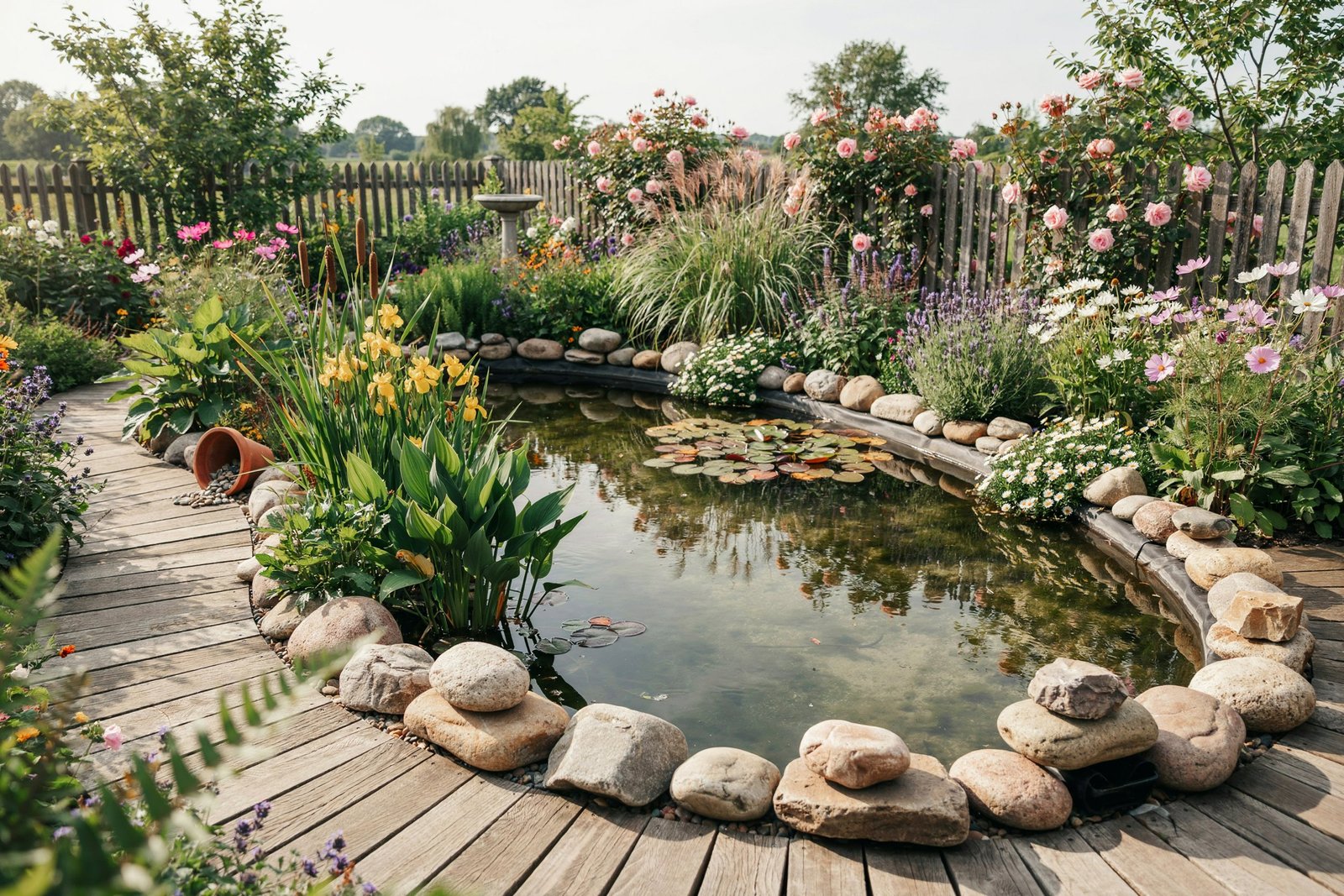

Creating a garden pond was one of those projects I thought would be simple: dig a hole, add a liner, fill it with water, and enjoy the view.
But a healthy pond is really a tiny ecosystem, and a few small planning mistakes can quickly turn that peaceful water feature into a frustrating chore.
I’ve learned that the prettiest ponds aren’t necessarily the biggest or most expensive ones.
They’re the ponds that are planned around their location, plants, wildlife, water quality, and the amount of maintenance the gardener can realistically manage.
If you’re dreaming of adding a pond to your garden, avoiding these common mistakes can save you time, money, and plenty of unnecessary headaches.
Why Planning Your Garden Pond Matters
A garden pond can become one of the most beautiful parts of a backyard. The sound of moving water, the reflections of plants on the surface, and the wildlife that eventually visits can make even a small garden feel more alive.
But a pond is also a living system.
Water temperature, sunlight, plants, fish, oxygen, organic debris, filtration, and water movement all affect one another. When one part is poorly planned, another part often suffers.
The good news is that you don’t need to be an expert pond designer to create something lovely. You simply need to think about how the pond will work before you start digging.
Here are 10 common garden pond mistakes I would avoid.
1. Choosing the Wrong Location

One of the first mistakes is choosing a pond location based entirely on appearance.
I completely understand the temptation to put a pond in the farthest corner of the garden because it looks like the perfect little hidden retreat. But if you can’t easily see or reach it, keeping up with maintenance can become much harder.
A pond should be somewhere you can comfortably enjoy and regularly check.
Think about sunlight
Your pond needs some sunlight, particularly if you want aquatic plants to thrive. However, placing it in intense, all-day sun can contribute to excessive heating and algae problems.
A partly shaded location can be easier to manage, especially in a hot climate. RHS guidance also recommends some shade while retaining enough sun to support plants and wildlife.
Think about trees
Building directly underneath large trees can create several problems.
Falling leaves and other debris can accumulate in the water, while extensive roots may make digging and construction difficult. You’ll also have more cleaning to do during seasons when trees shed heavily.
Don’t forget drainage
Avoid naturally low areas where rainwater from the surrounding garden can rush into the pond.
Runoff can carry soil, fertilizer, grass clippings, and other nutrients into the water. That extra material can make water quality much harder to manage.
Better approach: Choose a visible location with manageable sunlight, good drainage, convenient access, and enough space around the pond for maintenance.
2. Making the Pond Too Shallow

A shallow pond may look cute when you’re first building it, but water depth affects much more than appearance.
Very shallow water can warm quickly during hot weather and may lose water faster through evaporation. Excessive heat can contribute to lower oxygen levels and create stressful conditions for aquatic life.
However, this doesn’t mean every pond needs to be uniformly deep.
In fact, different depths can make a pond much more useful. Shelves and shallow margins provide areas for marginal plants and give wildlife easier access to the water.
For a general garden pond, the appropriate depth depends on its purpose, climate, plants, and whether fish will be kept.
RHS guidance notes that ponds should generally have at least one deeper section, while wildlife ponds benefit from a mixture of shallow and deeper areas.
Plan different levels
Instead of digging one large bowl, consider creating:
- A shallow wildlife shelf
- A planting shelf
- A deeper central area
- A gently sloping entrance or “beach”
This gives you more flexibility when choosing plants and makes the pond friendlier to wildlife.
Important: If you plan to keep fish, research the depth and volume requirements for the specific fish species and your local climate before construction.
Read Koi Pond Design: 8 Steps to Get It Right the First Time
3. Making the Pond Too Small for Your Plans

Small ponds can be wonderful. You absolutely do not need a huge backyard to enjoy water gardening.
The problem comes when the pond is made smaller than your intended use requires.
For example, you might imagine a pond with several large water lilies, lots of marginal plants, a waterfall, and fish. Then you build a tiny pond and discover that everything grows faster and takes up more space than expected.
Aquatic plants can spread considerably, and fish produce waste that affects water quality.
A small pond also gives you less room for changes in water temperature and nutrient levels.
Start with the purpose
Before deciding on the size, ask yourself:
- Do I want a wildlife pond?
- Do I want ornamental plants?
- Do I want fish?
- Do I want a fountain or waterfall?
- How much space can I realistically maintain?
- How much room do I have for equipment?
A wildlife pond can be quite small and still provide valuable habitat. The Natural History Museum notes that even tiny ponds can benefit insects, amphibians, and birds.
So the answer isn’t simply “make it bigger.”
The better lesson is: make the pond appropriate for what you want it to do.
Read How To Keep Mosquitoes Away From Your Pond (Naturally & Effectively)
4. Creating Steep, Difficult Edges

This is one of the pond mistakes that is easy to overlook while you’re digging.
A pond with very steep sides may seem efficient because you can create depth without making the pond very wide. But steep edges can make the pond less accessible to wildlife and make planting more difficult.
Frogs, insects, birds, and other small creatures benefit from shallow areas where they can safely enter and leave the water.
A gently sloping edge can also create attractive planting zones.
RHS wildlife-pond guidance recommends having at least one long, shallow slope, and the Natural History Museum similarly recommends shallow edges so wildlife can get out easily.
Try creating a pond “beach”
A shallow pebble or gravel margin can create a natural transition between the garden and water.
You can also use carefully positioned rocks, logs, or a suitable ramp where appropriate.
This isn’t just about making the pond prettier. It’s about creating a pond that works for the creatures that may eventually visit it.
5. Adding Tap Water Without Considering Water Quality

Filling a new pond with a hose may seem completely harmless, but the water you add can affect the developing pond ecosystem.
Tap water can contain chlorine or chloramine depending on the local water supply, as well as nutrients that may contribute to algae problems.
For wildlife ponds, rainwater is often preferred where practical. The Natural History Museum recommends collected rainwater for wildlife ponds and notes that leaving tap water standing can allow chlorine to dissipate, although other substances remain.
What should you do?
For a pond with fish or sensitive aquatic life, follow the recommendations for your local water supply and use an appropriate water conditioner when necessary.
For a wildlife pond, collecting rainwater can be a simple option if you have a clean collection system.
I also wouldn’t make dramatic water changes just because the pond doesn’t look perfectly clear. A natural pond doesn’t need to look like a swimming pool.
Some algae and microscopic organisms are normal parts of a pond ecosystem.
6. Adding Fish Too Soon
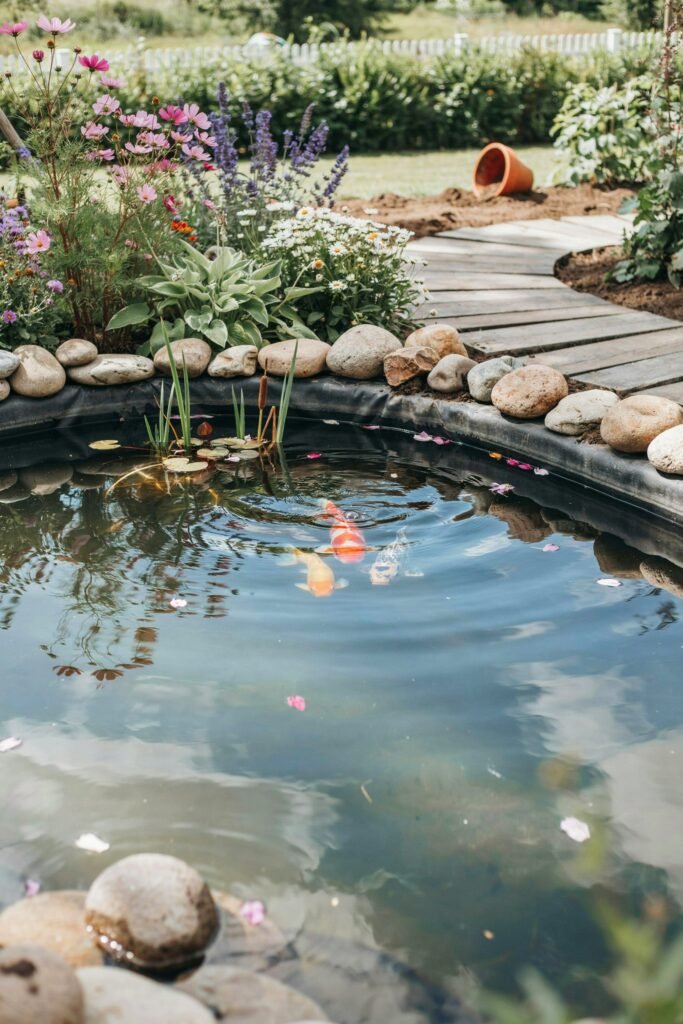
This is a mistake I would be especially careful about.
A newly constructed pond hasn’t had much time to develop its biological balance. Adding fish immediately can put extra pressure on a system that is still establishing itself.
Fish produce waste, and uneaten food adds additional nutrients. If the pond doesn’t yet have adequate biological filtration, plants, oxygen, and water volume, water quality can deteriorate.
The original Water Garden Advice guide recommends allowing a new pond time to establish before introducing fish.
Start slowly
Before adding fish, make sure:
- The pond is properly filled and functioning.
- Pumps and filtration are working correctly if required.
- Aquatic plants have been established.
- The water is suitable for the species you intend to keep.
- You understand the pond’s capacity.
- You have considered predator protection.
And don’t assume that a pond can support unlimited fish simply because there is plenty of visible water.
Read Butterfly Puddling Area: How to Create One in Your Garden
7. Overstocking Fish or Overfeeding Them

This is one of the fastest ways to create water-quality problems.
Fish waste and uneaten food add nutrients to the pond. Too many fish can overwhelm the pond’s natural processes, particularly in a small or poorly filtered system.
Oklahoma State University Extension explains that excess fish waste and uneaten feed can quickly degrade water quality, particularly when fish are overstocked or overfed.
Feed thoughtfully
If you’re keeping fish, give them only what they can reasonably consume rather than scattering large amounts of food.
Watch the fish while they eat.
If food is repeatedly left floating around the pond, you’re probably adding more than the fish need.
Don’t buy fish before checking capacity
I know how tempting it can be to see a beautiful fish at a garden center and think, “Just one more.”
But that little fish grows.
Always consider its mature size and the pond’s actual capacity before bringing it home.
A healthy pond isn’t about having as many fish as possible. It’s about maintaining a manageable balance.
8. Forgetting About Aeration and Water Movement

Still water isn’t automatically bad, especially in a wildlife pond. But ponds containing fish or designed around moving water may need good circulation and oxygen management.
Aeration can be provided through appropriately designed pumps, fountains, waterfalls, or dedicated aeration equipment.
Moving water can also make the pond more visually interesting.
If you notice unusual odors, stagnant areas, or fish repeatedly gathering at the surface, treat those as signs that something may need attention rather than simply adding more fish or chemicals.
The original reference guide highlights aeration as an important part of maintaining a healthy pond, while filtration and circulation needs vary depending on whether you’re creating a wildlife pond, ornamental pond, or fish pond.
Don’t overcomplicate a wildlife pond
This is important.
A wildlife pond does not automatically need a pump or filter. Natural wildlife ponds can function without mechanical filtration, and the Natural History Museum specifically notes that filters aren’t necessary for wildlife ponds.
If you do use a pump, make sure it is designed with wildlife protection in mind so small creatures aren’t accidentally drawn into the equipment.
9. Planting Too Little or Letting Plants Take Over
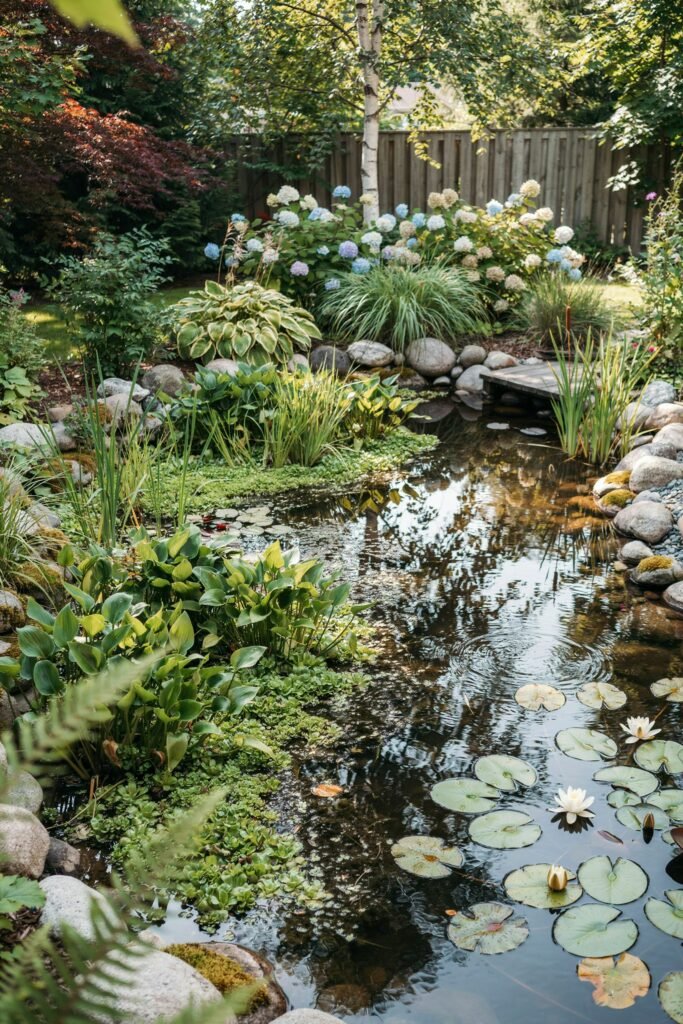
Aquatic plants are some of my favorite parts of a garden pond.
They soften hard edges, provide habitat, offer shade, and help create a more natural-looking water feature.
But there is a balance.
A pond with hardly any plants may have fewer natural ways to compete with algae for nutrients and light. On the other hand, a pond completely covered with plants can become difficult to maintain.
Oklahoma State University Extension notes that aquatic plants can help limit excessive algae by competing for light and nutrients, while RHS guidance recommends choosing plants according to the depth and eventual size of the pond.
Choose plants according to your pond
Don’t buy an aquatic plant simply because the label says it’s beautiful.
Check:
- Mature size
- Required water depth
- Sun requirements
- Growth habit
- Whether it spreads aggressively
- Whether it is suitable for your region
Some aquatic plants can spread rapidly, so RHS recommends checking their eventual size and being cautious about potentially invasive species.
Give plants room
I prefer to think of pond planting as layering.
Use some marginal plants around the edges, floating or surface-covering plants where appropriate, and deeper-water plants such as suitable water lilies.
Leave enough open water so the pond still feels like a pond.
10. Underestimating Pond Maintenance

This might be the biggest lesson of all.
A garden pond isn’t completely maintenance-free.
Even a beautifully balanced pond will experience seasonal changes.
Leaves fall.
Plants grow.
Pumps collect debris.
Water evaporates.
Algae appears.
Fish produce waste.
Plants may need dividing or thinning.
And after heavy rain, runoff may introduce unwanted debris into the water.
The key isn’t to create a pond that never needs attention. The goal is to create one that is easy enough to maintain consistently.
A simple pond maintenance routine
Weekly:
Check water levels, remove obvious debris, and look at fish or wildlife for unusual signs.
Every few weeks:
Check pumps, filters, skimmers, and plant growth if your pond uses these systems.
Seasonally:
Remove excessive dead plant material, thin vigorous plants, and prepare equipment for your local weather conditions.
After storms:
Check for runoff, muddy water, displaced rocks, damaged liners, and debris.
Don’t feel like you have to scrub every surface until the pond looks sterile.
A pond is supposed to be alive.
Bonus Mistake: Treating Every Pond Like a Swimming Pool
This is one mindset I think many new pond owners struggle with.
We often associate healthy water with perfectly clear, sparkling water.
But a garden pond is an ecosystem, not a swimming pool.
Some natural algae, microorganisms, plant debris, and changes in water appearance can occur as the ecosystem changes through the seasons.
Oklahoma State University Extension points out that water gardens operate differently from swimming pools and that aquatic plants play an important role in managing nutrients and algae.
Instead of trying to eliminate every tiny change, look at the whole pond.
Are the plants growing well?
Is the water moving appropriately for your pond design?
Are fish behaving normally?
Is there excessive debris?
Are algae problems persistent?
Is there a buildup of organic material?
Those questions tell you much more than appearance alone.
How to Plan a Garden Pond the Right Way
Before you pick up your shovel, I recommend making a simple plan.
Step 1: Decide what kind of pond you want
Choose between a wildlife pond, ornamental water garden, fish pond, or another specific purpose.
Step 2: Study your garden
Watch the area throughout the day.
Notice sunlight, shade, drainage, wind, nearby trees, and how easily you’ll be able to access the pond.
Step 3: Plan the depths
Include shallow areas and, where appropriate, a deeper section.
Step 4: Plan the edges
Make at least part of the pond accessible with a gentle slope, shallow shelf, ramp, or another safe exit route.
Step 5: Choose plants carefully
Think about mature size rather than how small the plant looks when you buy it.
Step 6: Decide whether you actually need fish
A pond can be beautiful without fish, and a wildlife pond may have very different requirements from a fish pond.
Step 7: Plan filtration and circulation
If you’re keeping fish or creating a heavily stocked ornamental pond, determine what filtration and circulation you’ll need before construction.
Step 8: Think about maintenance access
Make sure you can reach the pump, filter, pond edges, and plants without turning every cleaning session into a major project.
Final Thoughts
A garden pond doesn’t have to be perfect to be beautiful. In fact, some of my favorite ponds are the ones that feel like they’ve naturally settled into the garden rather than looking overly polished.
The biggest mistakes usually happen before the pond is even finished: choosing the wrong location, making it unsuitable for its intended purpose, skipping shallow areas, adding too many fish, choosing plants without considering their mature size, or forgetting that the pond will need regular care.
Take your time with the planning stage. Think about the wildlife, plants, water movement, sunlight, maintenance, and the overall size of your garden.
When those pieces work together, your pond can become much more than a pretty water feature. It can become a peaceful little ecosystem that brings movement, birds, insects, plants, and plenty of garden-life right outside your door.
